Eggs in the Christian tradition. Nicely done.
Orthodox Christianity
Two must reads this Paschal (Easter) season
First of all, why “Paschal”? The word comes from Pascha which means Passover and is the proper term for the resurrection of Christ. Christ is the “Paschal Lamb” (Passover Lamb). Think of John the Baptist’s words when he first laid eyes on Christ: “Behold the Lamb of God, who takes away the sins of the world.” To a first century Jew, the term “Lamb of God” would powerfully recall Exodus, when the angel of death passed over the homes of the Children of Abraham and the Egyptians during the final plague and killed all the first born sons of the families who did not place the blood of the unblemished lamb on their door posts. “Easter” is a later import and is not a historically proper term.
In any case, read these two articles about Pascha in Dachau:
Crisis in Indonesia
NEWS FROM THE ORTHODOX CHRISTIAN MISSION CENTER (OCMC)
FOR IMMEDIATE RELEASE
Crisis in Indonesia – March 19, 2007
The Metropolitanate of Hong Kong and Southeast Asia (Ecumenical Patriarchate) wishes to issue the following statement, concerning situations in Indonesia.
The Orthodox Christians in Indonesia have joined the list of those attacked by Muslim extremists. Father Methodios Sri Gunarjo, his family and other Orthodox were terrorized and threatened this past weekend. Although there are no reports of physical harm at this point, the verbal, psychological and other forms of abuse continue. At one point, a knife was put to the throat of Father Methodios, as his attackers demanded that he close the Churches in the Boyolali area of Central Java. It should be noted that there is a thriving ministry in this area.
A Journey That Will Come Full Circle and End With a Ring
New York Times (free registration required) Sergei Kivrin March 21, 2007
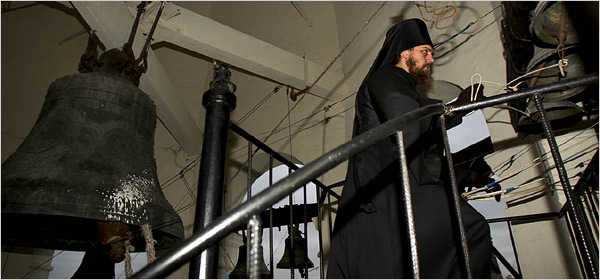
At the Danilov Monastery in Moscow, Hierodeacon Roman, a bell ringer, may be able ring the tower’s original bells by next year.
MOSCOW, March 20 — The bells of Lowell House at Harvard — so much a part of the university’s tradition that they have their own society of bell ringers — will soon return to the Russian monastery from which they were sold more than 70 years ago.
The Russian Orthodox Church and the university announced a final agreement on Tuesday to move the bells next year to Danilov Monastery, the residence of the Russian patriarch, after a replacement set for Harvard is completed.
The bells have become a symbol for the resurgence of the Orthodox Church and its drive, much like Russia’s, to reclaim its former glory.
Detroit A Foothold for Christian Orthodox Resurgence
Serbianna.com January 25, 2007
DETROIT (AP) — Detroit is emerging as a national center for the rebirth of Orthodox Christian churches, which have deep ethnic roots in Eastern Europe, the Middle East and North Africa.
Lefty political groups fund NCC
The Institute on Religion and Democracy released their report Yokefellows that examines the funding sources for the National Council of Churches (NCC). It’s not pretty. The Tides Foundation and other leftwing groups contribute a good chunk of change. Read the Executive Summary.
I got an advance copy a month or so ago. Read my comments.
Panorama of Constantinople
Why not “Istanbul”? Because the name Istanbul is really an Arabic derivative of the Greek. If you live near New York City for example and are heading into Manhattan, you don’t say “I am going to New York City.” Instead, you say “I am going to the city.”
Well, the “Istanbul” means the same thing. “Ee steen polee” is the Greek way of saying in the city (in this case the “city of Constantine” or Konstanteen-oupolee — Constantinople in English). Change the the Greek hard “p” to the Arabic hard “b” and you end up with “ee-stan-bolee” or Istanbul. The Arab speakers in Turkey know this of course. Non-Arabic speakers think the name of Constantinople actually was changed.
Islam gets concessions; infidels get conquered
LA Times Raymond Ibrahim December 5, 2006
What they capture, they keep. When they lose, they complain to the U.N.
IN THE DAYS before Pope Benedict XVI’s visit last Thursday to the Hagia Sophia complex in Istanbul, Muslims and Turks expressed fear, apprehension and rage. “The risk,” according to Turkey’s independent newspaper Vatan, “is that Benedict will send Turkey’s Muslims and much of the Islamic world into paroxysms of fury if there is any perception that the pope is trying to re-appropriate a Christian center that fell to Muslims.” Apparently making the sign of the cross or any other gesture of Christian worship in Hagia Sophia constitutes such a sacrilege.
Orthodox Priest Beheading and Recent White House Omission
Religious News Service October 13, 2006
Lead to Call for American Protection of Pope and Ecumenical Patriarch Meeting in Turkey
Yesterday’s reported beheading of an Orthodox Priest and a recent White House omission during a meeting between President George W. Bush and Turkish Prime Minister Tayyip Erdogan increased concerns about protecting the spiritual heads of the two largest Christian denominations, while in Turkey together. Catholicism’s Pope Benedict XVI and Orthodoxy’s Ecumenical Patriarch Bartholomew will be meeting in Turkey in late November. Turkey is the first Muslim country that Pope Benedict will visit. Until the year 1054, the Pope and Ecumenical Patriarch were presiding Patriarchs of the then-undivided Christian Church, in Rome and Constantinople.
Desert Prayer With Egyptian Roots
Los Angeles Times David Kelly July 3, 2006
Life at North America’s only Coptic Orthodox monastery is rigorous and strictly for worship. It draws those who seek a deeper insight into Christianity.
NEWBERRY SPRINGS, Calif. — Down an unpaved road, past brooding icons and swaying stands of mesquite, lies St. Antony’s Monastery, a place of scorching winds and emptiness that perhaps only a holy man could love.